


Marching to Harmony: Martin Rucker Is Using Music to Build Opportunity, Confidence and the Next Generation of Creators


By Voices of the Village Podcast
When most people think about youth development, athletics often comes to mind first. Football leagues, basketball programs, baseball teams and recreation centers have long created structured spaces where young people can sharpen their skills, develop confidence and dream about the next level.
But what about the young musician holding a trumpet? What about the drummer searching for a place to practice?
What about the student who has talent but cannot afford an instrument? And what about the young creative who dreams of becoming a producer, entertainment attorney, media professional or music entrepreneur? Those are the young people Marching to Harmony is working to reach.
During a recent episode of Voices of the Village Podcast, host Andreal “Country Fly” Mallard sat down with philanthropist, entrepreneur and business owner Martin Rucker for a conversation about music, education, opportunity and the mission behind Marching to Harmony.
For Rucker, the organization is about much more than putting a band together. It is about using music as a gateway to education, scholarships, creativity, discipline and opportunity.
Creating a Path to College Through Music
Rucker explained that Marching to Harmony was established with a central mission: helping young people obtain college scholarships through music. The organization currently has a strong connection to Historically Black Colleges and Universities, while its broader goal is to create opportunities for students wherever music can help open a door to higher education.
Marching to Harmony organizes its mission around the acronym S.I.T.E. — Scholarships, Instruments, Tutorials and Events. The first component is Scholarships. The organization wants young musicians to understand that their talent can potentially become more than an extracurricular activity. With preparation, discipline and exposure, musical ability can help students create pathways toward college.
The second component is Instruments. If community members have instruments they are no longer using, Marching to Harmony can receive those instruments, work to refurbish them and place them in the hands of students who may not otherwise be able to afford one.
For families facing financial challenges, the cost of an instrument can become the difference between a young person participating in music or walking away from it completely. Marching to Harmony wants to help eliminate that barrier.
The third component is Tutorials. The vision is to provide students with free instruction and training designed to strengthen their musical ability. Better musicians become better prepared for auditions, performances and scholarship opportunities. Finally, there are Events and this is where Marching to Harmony has built one of its most visible platforms.
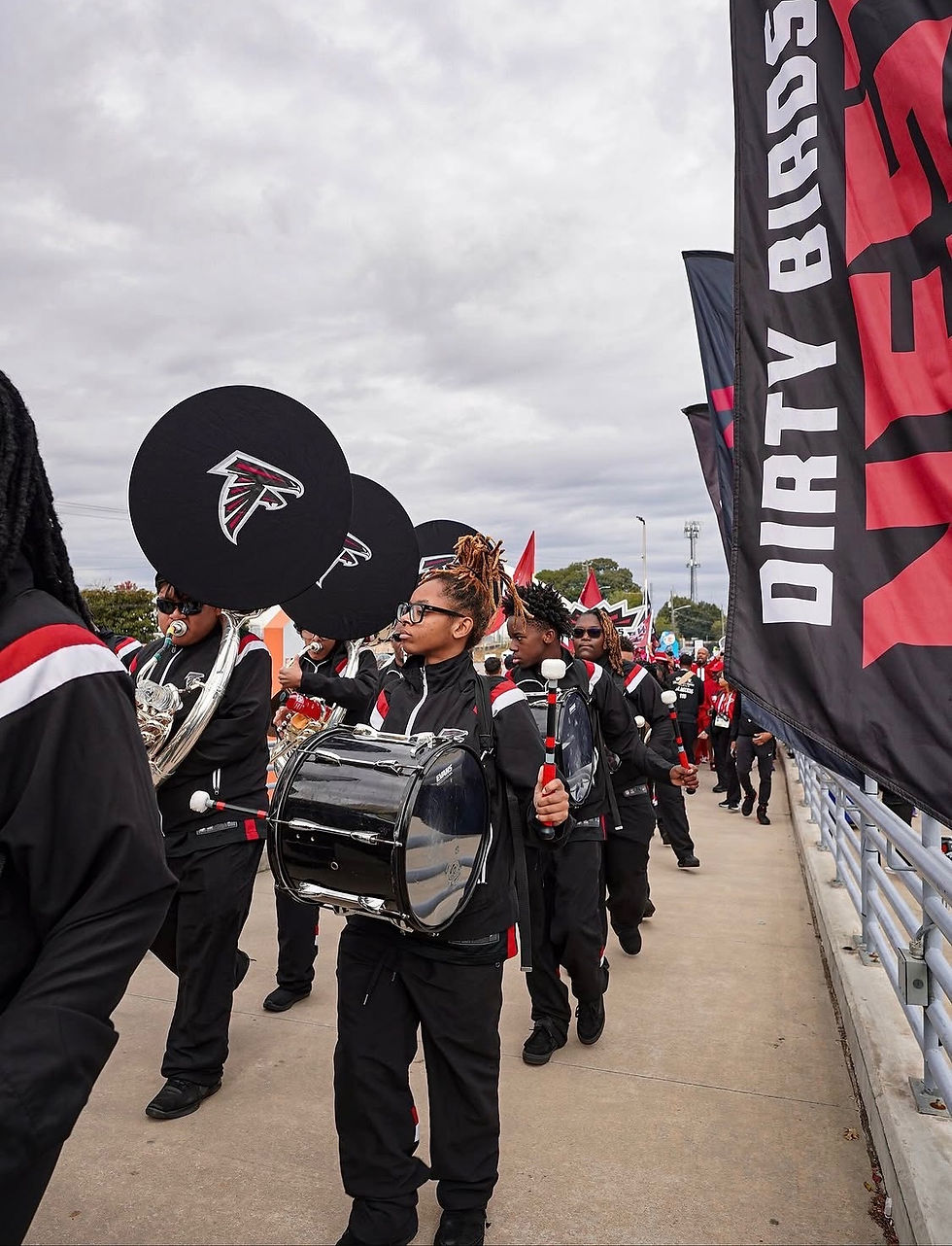
From the Community to Mercedes-Benz Stadium
Marching to Harmony serves as the official drumline for the Atlanta Falcons, according to Rucker. For approximately eight years, young performers connected to the organization have been given the opportunity to experience the atmosphere surrounding Atlanta Falcons games and perform before massive crowds.
For a developing musician, that kind of experience can be transformational. Performing in front of tens of thousands of people demands confidence, preparation, teamwork and composure.
Rucker believes those experiences prepare students for what comes next. If a teenager can perform in front of a packed professional football stadium, the pressure of a college audition, campus performance or future professional opportunity may not feel quite as intimidating.
It is exposure with a purpose. The lights, crowds and excitement are memorable, but behind the performance is a larger lesson: young people learn how to rise to the occasion.
How Marching to Harmony Began
Rucker is a graduate of Albany State University, and the foundation for Marching to Harmony can be traced back to his college relationships. He credited one of his college roommates, H.T. Montay, as the brainchild behind the organization. The conversation was simple.
Montay had the idea for a nonprofit centered around young musicians and asked Rucker if he was willing to help build it. Rucker was in.
They began working on the organization around 2018, completing the necessary foundation and paperwork before moving the organization forward in 2019. One of their significant early opportunities came when the Atlanta Falcons entrusted the organization with becoming part of the game-day experience. But even with major exposure, building a music-centered nonprofit has not always been easy.

The Funding Gap Between Sports and Music
One of the most important moments in the conversation centered around funding. Rucker pointed to something many parents and educators already recognize: youth sports infrastructure is everywhere. Young athletes can begin organized training at extremely young ages. There are leagues, camps, private coaches, travel teams and specialized facilities dedicated to developing athletes.
Music does not always receive that same level of investment. That funding gap can become especially difficult in public schools. Rucker shared that Marching to Harmony has received calls from schools seeking basic materials such as drumsticks.
That reality illustrates the larger challenge. Music educators are often being asked to build programs, inspire students and maintain instruments while operating with limited resources. Marching to Harmony wants to become part of the solution.
The organization is calling on businesses, community leaders and supporters throughout Atlanta and Georgia to recognize music education as an investment in youth development. Because the next great musician, producer, songwriter, composer or entertainment executive cannot develop without an opportunity to begin.
The Bigger Vision: A Free After-School Music Environment
Rucker's long-term vision for Marching to Harmony extends far beyond performances. He wants to create an after-school environment built around music, creativity and entertainment. His proposed price for students? As he jokingly described it: “Free 99.” In other words, free. Rucker envisions a place where young people can come after school and learn in a creative environment instead of being left without productive options.
Inside that environment, students could learn from working professionals throughout the entertainment industry.
A producer could teach music production. A pianist could teach piano. A horn player could teach trumpet. An entertainment attorney could explain contracts, intellectual property and the business side of music.
Media professionals could introduce students to broadcasting, photography, videography, podcasting and entertainment media. Students could learn that the music industry is not limited to being the person holding the microphone.
There are careers in production, marketing, law, management, engineering, journalism, broadcasting, technology and countless other areas. Rucker even pointed to his own family as an example of how the industry is evolving, noting that his daughter graduated from Kennesaw State University with a degree in media and entertainment.
The educational infrastructure surrounding music and entertainment is growing. Marching to Harmony wants young people to be prepared to take advantage of it. Music Creates Emotion And Creators
During the conversation, Rucker was asked about the influence music has on today's generation. His answer went directly to the emotional power of sound. Music makes people feel something. Gospel can move someone spiritually.
Rap can create energy. Country music can tell stories. Rock can create an entirely different emotional experience.
Athletes use music before games to increase focus and motivation. Families use music during celebrations. Churches use music during worship. Movies use music to shape emotion.
Music is woven throughout everyday life.
For Rucker, that emotional connection is also tied to something deeper: creativity. Marching to Harmony does not simply want to create musicians. It wants to create creators. Young people who can imagine something that does not exist and build it. Young people who discover their voice. Young people who gain enough confidence to perform in front of thousands.
Young people who learn that an instrument, laptop, microphone, camera or mixing board can become a pathway toward an entirely different future. That message strongly connected with Mallard, who shared during the conversation that before becoming known throughout the community as a media entrepreneur, he once performed music under the name Country Fly.
For him, performing was about more than entertainment. It provided an outlet. It created a voice. And it allowed creativity to become a form of expression. That is exactly the type of opportunity organizations like Marching to Harmony are working to protect.

More Than a Drumline
It would be easy to see Marching to Harmony performing during an Atlanta Falcons event and simply recognize a talented drumline. But behind every performance is a larger mission. Scholarships. Instruments. Tutorials. Events. Mentorship, Exposure, Education, Career development. And most importantly, opportunity.
Martin Rucker and the Marching to Harmony team are working to ensure that talented young musicians are not forgotten simply because music programs do not receive the same attention or resources as other youth activities.
Their vision is ambitious: keep music alive, build young creators and establish spaces where students can develop their talents without financial barriers standing in their way.
That mission is bigger than one performance at Mercedes-Benz Stadium. It is about what happens after the final drumbeat. It is about helping a young person recognize that their talent could lead somewhere. Maybe to an HBCU.
Maybe to another university. Maybe into music production. Maybe into entertainment law. Maybe into broadcasting. Maybe onto the biggest stages in the world. But before any of those things can happen, somebody has to give that student an opportunity to begin. That is where Marching to Harmony is stepping in.
Voices of the Village Podcast — Where Change Starts With Conversation.


Comments